Written From… a train on the way back to London, UK
There are few places where history and imagination seem so closely intertwined as Oxford and Cambridge. Their colleges, libraries, and riversides have shaped not only the English education system, but the English sense of creativity itself. To walk through them is to move through a living essay — one written in stone, water, and thought.
If you’re travelling to England, take the time to visit these small cities for a day. They are compact, walkable, and each reveals a different side of the country’s mind — one rooted in reflection, the other in discovery.
Oxford: The Architecture of Thought
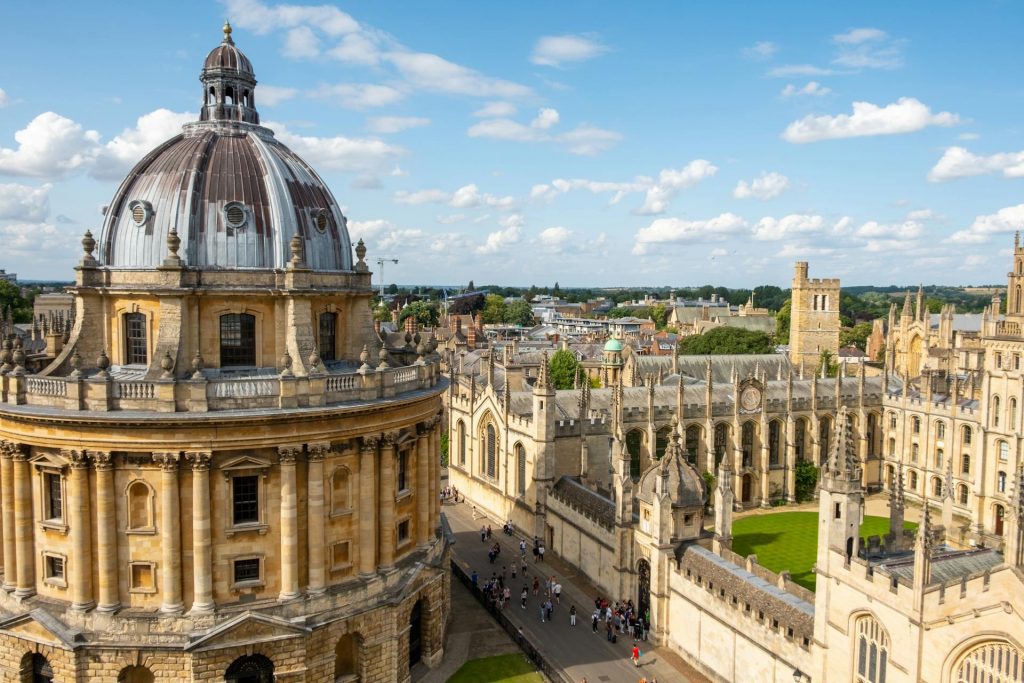
Oxford appears first as a skyline of towers and spires, built from the same pale stone that seems to hold the colour of centuries. The rhythm of bells, the sound of bicycle wheels on cobbles, the slow turning of pages in old libraries — everything here feels deliberate.
Inside the Bodleian Library, the air carries the quiet weight of concentration. Its carved ceilings and oak shelves speak of continuity: generations of readers seeking meaning in the same soft light. The imagination here feels disciplined — formed by tradition and guided by ritual. Among those who studied here were John Locke, the philosopher who laid the foundations of modern liberal thought, and Oscar Wilde, who read classics before becoming one of literature’s sharpest wits. Both reflect something of Oxford’s dual spirit — Locke’s rational clarity and Wilde’s creative rebellion — ideas born in the same city but heading in different directions.
A short walk away, Magdalen College offers a gentler side of the city. C.S. Lewis, who taught English literature here, once walked its cloisters and deer park, forming the ideas that would become The Chronicles of Narnia. The stillness of the lawns, the sound of footsteps on stone — you can see how imagination might begin here, in a place that leaves room for wonder.
Further along St Giles’, The Eagle and Child pub welcoming people in 1940s, now sadly closed but set to hopefully reopen, is where Lewis met regularly with J.R.R. Tolkien, author of The Lord of the Rings. They would meet here with their informal literary group, the Inklings. Looking at the pub I imagined if the clatter of glasses and low conversation had inspired parts of Tolkien’s world — the kind of setting where friendship and story might have grown together.
At Christ Church, Lewis Carroll, who lectured in mathematics, found the seeds of Alice’s Adventures in Wonderland. His love of logic and play combined perfectly in a city that treats both as forms of art. Oxford’s creativity, it seems, was built not on escaping order, but on finding invention within it.
Before leaving, it’s worth exploring beyond the main sights — the quiet gardens of New College, the vaulted calm of University Church of St Mary the Virgin, or the old shelves of Blackwell’s Bookshop. Each corner holds another trace of the past. Go and explore; let me know what you learn.
Cambridge: The Lightness of Being
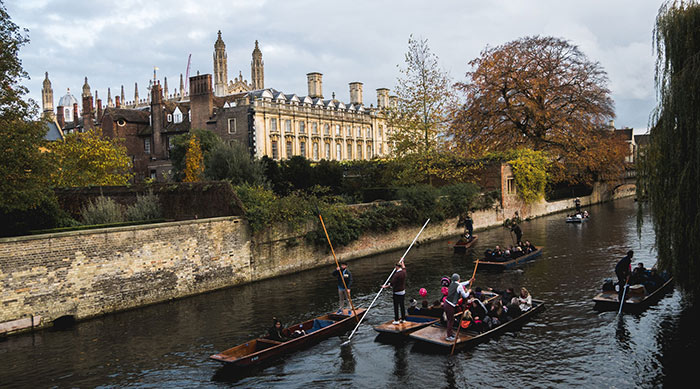
If Oxford looks back to its origins — steeped in theology, philosophy, and the classical education that shaped English letters — Cambridge looks forward. Where Oxford nurtured writers, poets, and theologians, Cambridge became home to scientists, reformers, and innovators. The difference lies not only in architecture, but in temperament: Oxford preserves; Cambridge experiments.
In Trinity College Library, the air hums with precision. Isaac Newton studied and later taught here, developing his laws of motion and the theory of gravity. His desk still stands near a window, the light falling across it as if on purpose. You sense in this space a quieter kind of imagination — not storytelling, but problem-solving, the patience of minds that look for patterns where others see chaos.
King’s College Chapel is Cambridge’s heart, vast and balanced, its fan vaulting drawing the eye upward. When the choir sings, the sound fills every corner of the space, transforming structure into something deeply human. Visitors can still attend Evensong, and it remains one of the most moving experiences in England — faith, architecture, and music woven into one calm moment.
A short cycle out of town leads to Grantchester, where The Orchard Tea Garden still serves under apple trees. Rupert Brooke, the poet who lived there before the First World War, wrote about youth, love, and a longing for home — most famously in The Soldier. He and his friends from the Bloomsbury Group once gathered here for tea, argument, and sunlight. The garden still feels peaceful, though I wonder how similar it is today; perhaps the chairs are newer, the trees a little older, but the same unhurried spirit lingers in the air.
Between Them: The Conversation Continues
Oxford and Cambridge are often compared, but they’re better understood as counterparts — two halves of the same impulse. Oxford looks inward because it was built on continuity: theology, philosophy, the inheritance of thought passed down like a text to be read and reread. Its imagination is steeped in reflection — it perfects, refines, and interprets.
Cambridge, by contrast, looks outward. Its history leans toward science and innovation: the discovery of DNA, the birth of computing, the theories that reshaped how we see the universe. Its imagination is experimental — not content to preserve, but to question.
Travelling between the two, the countryside blurs into hedgerows and fields. It’s easy to picture generations who have made this same journey — scholars, poets, reformers — carrying their own small versions of the imagination across the landscape. Between them lies the essence of English creativity: the balance between tradition and progress, reflection and exploration.
The Imagination as a Place
By evening, the light along the Cam turns silver. Bells sound across the water, and the city grows still. What remains, after all the stories and theories, is a sense of continuity — of minds that have walked these same paths, looked at these same skies, and wondered in much the same way.
The imagination of England isn’t confined to libraries or chapels. It lives in the texture of these cities — in the way a thought seems to echo down a corridor, or how the light falls across a courtyard. Oxford gives it form; Cambridge gives it movement. Together, they remind you that creativity is not only about invention, but about attention — about seeing the familiar and thinking again.
Oxford & Cambridge Highlights
Oxford
- Bodleian Library – Studied by John Locke (philosopher, modern liberal thought) and Oscar Wilde (writer, wit, social critic).
- Magdalen College – C.S. Lewis (taught English literature; author of The Chronicles of Narnia).
- The Eagle and Child Pub – J.R.R. Tolkien (author of The Lord of the Rings) and the Inklings literary group.
- Christ Church – Lewis Carroll (lectured in mathematics; wrote Alice’s Adventures in Wonderland).
- Other suggestions – New College gardens, University Church of St Mary the Virgin, Blackwell’s Bookshop.
Cambridge
- Trinity College Library – Isaac Newton (studied and taught; laws of motion, gravity).
- King’s College Chapel – Attend Evensong choir (experience architecture, music, and history).
- Grantchester / Orchard Tea Garden – Rupert Brooke (poet; wrote The Soldier, Bloomsbury connections).
- Other suggestions – Punting along The Backs, explore King’s College lawns, cycle through college courtyards.